You want your Tesla to behave like a slightly paranoid health tracker that nags you before anything expensive breaks. Fair. The car already does some of this… but naturally, humans decided that wasn’t enough data and built an entire ecosystem of apps to obsess over it.
Short answer: yes, AI-driven tools (and “AI-adjacent” analytics apps) can monitor your Model 3 Performance’s battery health, efficiency, and faults, and even alert you early. Just don’t expect magic mind-reading. It’s data analysis, not clairvoyance.
What Your Tesla Already Does (Before You Add Anything)
Your car isn’t clueless. It already tracks:
Built-in monitoring
- Battery charge, range, and consumption
- Charging behaviour and efficiency
- Thermal management (battery temperature control)
- Alerts for faults or degradation
Tesla even provides:
- A quick in-app diagnostic scan
- A full 24-hour battery health test in service mode
That test measures capacity fade (how much usable energy you’ve lost over time), which is the real definition of battery health.
So technically, yes, Tesla already “checks itself.”
But… it’s like a doctor who only speaks when something is already wrong.
Where AI Tools Come In (The Bit You Actually Care About)

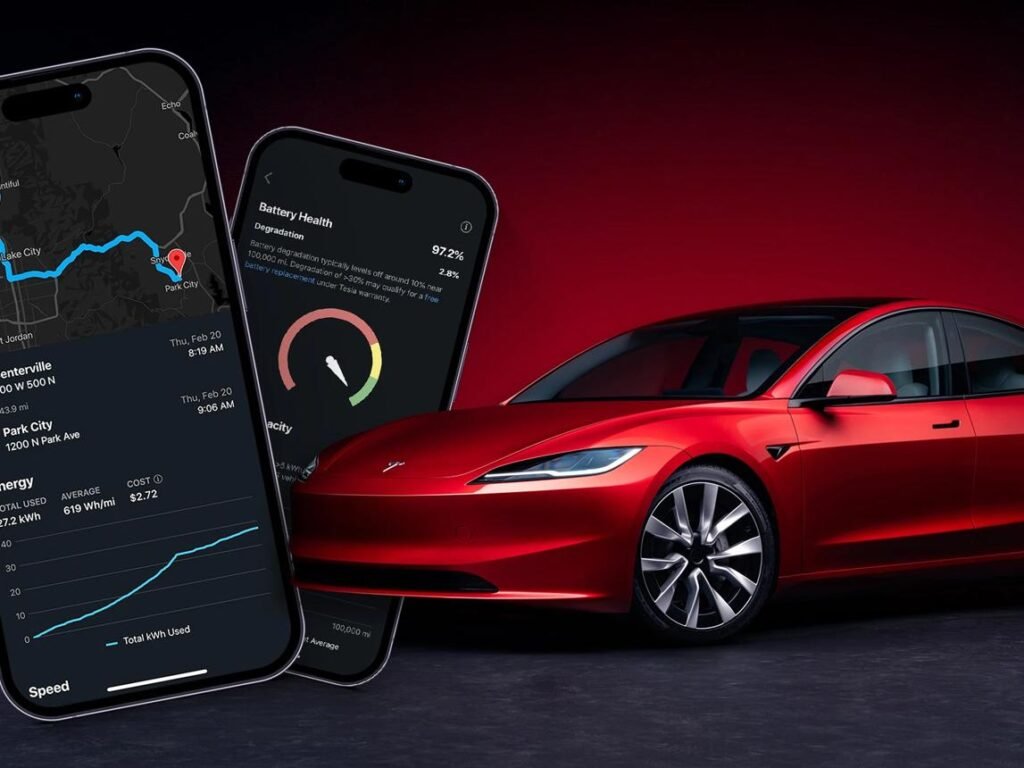
Third-party tools sit on top of Tesla’s data and act like obsessive analysts.
Popular ones include:
- Tessie
- TeslaFi
- TezLab
- TeslaMate (self-hosted)
These use Tesla’s API to pull real-time and historical data
What they actually do (the useful bit)
- Track battery degradation over time
- Analyse efficiency (Wh/mile or Wh/km)
- Monitor charging patterns and costs
- Detect abnormal energy loss (“vampire drain”)
- Log every trip, temperature, and usage variable
- Send alerts when something deviates from normal
Some apps (like Tessie) explicitly include:
- Battery health scoring
- Lifetime analytics
- Automation and alerts
And yes, they can feel eerily intelligent because they compare your behaviour against historical data and other vehicles.
So… Is This “AI” or Just Fancy Graphs?
Let’s not oversell it like a marketing brochure.
Reality check
- Most tools are advanced analytics + pattern detection
- Some use machine learning models to estimate degradation trends
- None are predicting the future like a sci-fi film
They’re basically:
“You used 12% more energy than usual yesterday… something’s off.”
Which, to be fair, is still pretty useful.
What Problems Can Actually Be Detected?
Here’s where it becomes genuinely valuable:
Battery health issues
- Faster-than-expected degradation
- Reduced maximum range
- Uneven charge behaviour
Efficiency problems
- Sudden drop in miles per kWh
- Increased energy consumption in similar conditions
- Driving pattern inefficiencies
Early fault indicators
- Charging irregularities
- Temperature anomalies
- Unexpected standby drain
These tools don’t fix anything, but they spot trends before Tesla’s system shouts at you.
What They Can’t Do (Despite What People Hope)
Humans love to believe software will save them from expensive mistakes. It won’t.
Limitations
- Cannot physically inspect battery cells
- Cannot predict exact failure timing
- Cannot override Tesla’s internal diagnostics
- Dependent on Tesla’s data accuracy
Even Tesla’s own system is estimating battery health, not measuring it directly.
And yes, sometimes the apps disagree slightly with Tesla’s official test
Advertisement

- Spacemax: Now you can get the best of both worlds with SpaceMax. Thin walls mean more space for food storage on the insi…
- AI Energy Mode: Reduce your energy use by up to 10%¹ with AI Energy mode². In Maximum mode, AI energy is always on and i…
- 5YR Assurance / 20YR Compressor: Samsung refrigerators offer innovative features and durable performance, plus a 5 year …
The Slightly Awkward Bit: Data & Privacy
To use these apps, you give them access to your Tesla account.
That includes:
- Location
- Driving history
- Charging behaviour
Tesla makes it clear:
You choose what data to share, and you can revoke access anytime
So you’re basically handing over a diary of everywhere your car has ever been. Hope you’re not pretending you only went to the gym.
Expert-Level Take (Without the Hype)
If you actually care about battery longevity and efficiency:
- The Tesla app = basic health check
- Third-party tools = long-term analytics + early warning system
Used properly, they give you:
- Evidence of degradation (useful for warranty claims)
- Insight into inefficient driving or charging habits
- Early detection of unusual behaviour
Used badly, they give you:
- Anxiety about numbers that don’t matter
- A hobby you didn’t ask for
Bottom Line (Brace Yourself)
Yes, an AI-style tool can absolutely monitor your Tesla Model 3 Performance and alert you to problems.
But here’s the honest version:
- It won’t save you from physics
- It won’t magically extend battery life
- It will make you stare at graphs more than necessary
Still… if you’re running a £50k+ machine, having a digital watchdog quietly analysing everything is not the worst idea humans have had this decade.
AI Playbooks
We have created Professional High Quality Downloadable PDF’s at great prices specifically for Personal or Business use in the UK. Which include help and advice on understanding what Artificial Intelligence is all about and how it can improve your business. Find them here.