Accountants in the UK are not sitting in dark rooms whispering “debits and credits” into Victorian ledgers anymore. Most firms, from tiny two-person practices in Leeds to large London advisory firms, are now experimenting with or actively deploying artificial intelligence across bookkeeping, tax, compliance, forecasting, fraud detection and client communication.
What is interesting is that AI is not replacing accountants in the way social media doom prophets promised. It is mostly replacing repetitive admin, reducing low-value manual work, and pushing firms towards advisory services where humans still matter. Irritatingly for anyone hoping robots would finally remove tax returns from civilisation entirely, HMRC still expects qualified humans to sign things off.
Industry bodies including the Institute of Chartered Accountants in England and Wales (ICAEW) now openly provide AI guidance and training because adoption has become unavoidable across the profession.
The Real Reason UK Accountants Are Turning to AI
Staff shortages and rising workload
Many UK accountancy firms are under pressure from:
- Making Tax Digital (MTD)
- Increased compliance demands
- Labour shortages
- Clients expecting instant answers
- Rising operational costs
- Competition from online accounting platforms
AI helps firms process more work without dramatically increasing staff numbers.
According to recent ICAEW reporting and industry analysis, firms increasingly see AI as a practical productivity tool rather than an experimental technology project.
Clients now expect faster answers
Small business owners increasingly expect:
- Real-time cash flow updates
- Faster bookkeeping
- Automated reporting
- Forecasting dashboards
- Quick VAT explanations
- Predictive financial advice
Traditional “we’ll get back to you in two weeks” accounting no longer competes well against AI-enhanced firms delivering answers in minutes.
AI Bookkeeping Is Becoming Normal
Automated invoice processing
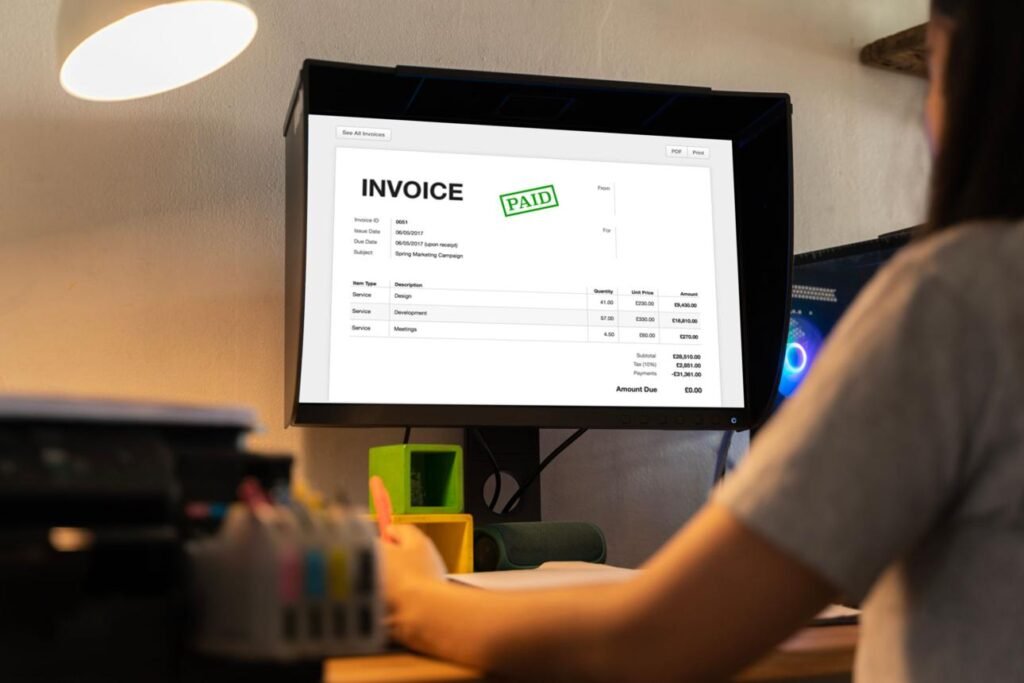
One of the biggest AI use cases is invoice and receipt extraction.
Modern accounting systems can now:
- Read receipts automatically
- Categorise transactions
- Suggest VAT treatments
- Match invoices to bank feeds
- Detect duplicate expenses
- Flag unusual spending patterns
Platforms such as Xero, QuickBooks and Sage increasingly use machine learning to automate bookkeeping workflows.
Real-world example
A small Manchester accountancy practice handling trades businesses may previously have spent:
- 20 hours monthly processing receipts
- 8 hours reconciling bank feeds
- 5 hours correcting categorisation mistakes
With AI-enabled bookkeeping tools:
- Receipt extraction becomes near-instant
- Reconciliation is largely automated
- Human review focuses only on exceptions
That can reduce bookkeeping time by more than half in some firms.
AI is also reducing simple human errors
Manual bookkeeping mistakes remain one of the biggest causes of:
- VAT issues
- duplicate transactions
- missed invoices
- reporting inaccuracies
AI systems can flag anomalies quickly, especially when transaction patterns suddenly change.
HMRC itself has acknowledged that AI-enabled bookkeeping tools are increasingly capable of contextual classification rather than basic rule matching alone.
AI Is Changing Tax Preparation

Faster tax return preparation
Tax work remains heavily human-reviewed because UK tax legislation is messy enough to make even advanced AI systems occasionally hallucinate nonsense with complete confidence. A surprisingly human characteristic.
However, AI is increasingly helping accountants:
- prepare draft tax returns
- identify missing documents
- summarise client financials
- analyse expenses
- detect inconsistencies
- generate client explanations
Making Tax Digital is accelerating adoption
MTD requirements are pushing firms towards automation.
The April 2026 expansion of Making Tax Digital for Income Tax has increased urgency for digital workflows.
Firms that still rely heavily on spreadsheets and paper documentation are struggling to keep up efficiently.
AI still cannot replace professional judgement
UK accountants repeatedly stress that AI cannot fully handle:
- complex tax planning
- nuanced VAT interpretation
- business restructuring advice
- HMRC investigations
- director liability issues
- compliance sign-off
Industry commentary continues to emphasise that qualified accountants remain essential because regulation and judgement cannot be fully automated.
Accountants Are Using AI for Advisory Work

Forecasting and cash flow prediction
This is where many firms now see the biggest opportunity.
AI systems can analyse:
- seasonal trends
- customer payment patterns
- supplier costs
- payroll growth
- inflation effects
- recurring spending
This allows accountants to provide more proactive advice.
Real-world example
An accountant working with a UK hospitality business might use AI forecasting tools to predict:
- likely cash flow shortfalls
- VAT pressure periods
- staffing cost increases
- seasonal revenue drops
Instead of merely reporting what already happened three months ago, the accountant becomes a business adviser.
That shift is transforming the economics of accountancy firms.
Firms are charging more for insight
Basic bookkeeping is becoming commoditised.
Advisory services now generate higher margins because clients pay for:
- interpretation
- strategic planning
- forecasting
- risk reduction
- business growth advice
AI helps accountants deliver those services faster.
AI in Auditing and Fraud Detection

Large firms are heavily investing in AI
Major firms including Deloitte and KPMG are already using internal AI tools to:
- analyse large datasets
- identify anomalies
- summarise documentation
- automate audit workflows
- assist junior staff
Deloitte reportedly saw dramatic growth in usage of its internal AI chatbot among audit staff.
Fraud detection is becoming more advanced
AI can detect unusual patterns humans may miss, including:
- duplicate invoices
- suspicious payroll changes
- unusual supplier activity
- abnormal payment timing
- inconsistent expense claims
This is particularly useful in larger organisations processing huge transaction volumes.
Human oversight still matters
Audit regulators remain cautious.
Professional bodies continue emphasising:
- documentation standards
- explainability
- audit evidence quality
- ethical usage
- data governance
AI outputs cannot simply be trusted blindly because models occasionally produce confident fiction. Which, to be fair, also describes some corporate board meetings.
AI Customer Service Inside Accounting Firms
AI chatbots for client support
Many firms now use AI chat assistants to answer common questions such as:
- “When is my VAT due?”
- “What expenses can I claim?”
- “Have you received my records?”
- “What does this HMRC letter mean?”
This reduces admin workload significantly.

- 【5000Pa Deep Clean for Pet Owners】 – Don’t let pet hair take over your home. The UR1’s industry-leading 5000Pa suction p…
- 【Smart Carpet Boost & Anti-Tangle Technology】 – Tired of cleaning hair off your vacuum roller? So are we. UR1 features a…
- 【Ultra-Slim 2.99″ Design for 2100 sq.ft. Whole-Home Cleaning】 – Glides under beds, sofas, and low-profile furniture to e…
AI email drafting
Accountants increasingly use generative AI to:
- draft client emails
- summarise meetings
- create engagement letters
- explain tax changes in plain English
- generate reports
The final output is usually reviewed by humans before sending.
Faster onboarding
Some firms now automate client onboarding using AI to:
- verify submitted documents
- extract ID details
- categorise business types
- identify compliance requirements
This speeds up client acquisition dramatically.
The Biggest Risks UK Accountants Face with AI

Client confidentiality and GDPR
This is one of the largest concerns.
Accounting firms handle highly sensitive data including:
- payroll
- bank details
- tax references
- personal income
- company financials
Using public AI tools carelessly can create major compliance risks.
Recent UK guidance stresses that firms remain responsible as data controllers under UK GDPR even when third-party AI platforms process information.
Hallucinations and inaccurate advice
Generative AI can produce incorrect tax explanations or fabricated legal interpretations.
This creates obvious problems when:
- filing VAT returns
- interpreting HMRC guidance
- handling tax disputes
- giving compliance advice
Most firms therefore use AI as an assistant, not a decision maker.
Skills gaps inside firms
Many accountants still do not fully understand:
- prompt engineering
- AI limitations
- data governance
- AI security
- automation design
That is why ICAEW and Microsoft launched dedicated AI training programmes for accountants.
Will AI Replace UK Accountants?
Short answer: no
The profession is changing, but accountants are not disappearing.
AI is removing repetitive work such as:
- data entry
- reconciliation
- document summarisation
- basic reporting
But businesses still need humans for:
- trust
- judgement
- interpretation
- strategy
- regulation
- reassurance during HMRC disputes
And frankly, business owners still panic the moment a tax letter arrives, so human accountants are not going extinct anytime soon.
Junior roles are changing though
Entry-level bookkeeping and admin work may reduce significantly.
That means junior accountants increasingly need skills in:
- analysis
- advisory work
- communication
- automation oversight
- AI governance
Large firms are already restructuring training around AI-assisted workflows.
The AI Tools UK Accountants Commonly Use
Cloud accounting platforms
Popular platforms include:
- Xero
- QuickBooks
- Sage
- FreeAgent
AI productivity tools
Many firms also use:
- Microsoft Copilot
- OpenAI ChatGPT
- document automation tools
- AI note-taking platforms
- workflow automation systems
Robotic Process Automation (RPA)
Some larger firms use RPA bots for:
- payroll processing
- invoice handling
- reporting workflows
- bank reconciliation
- compliance checks
Industry analysis suggests RPA adoption is growing rapidly within London and UK finance environments.
What UK Businesses Should Learn From This
Your accountant probably already uses AI
Even if they do not advertise it openly.
Many firms quietly use AI behind the scenes because:
- it saves time
- reduces repetitive work
- improves responsiveness
- increases profitability
Businesses should ask better questions
Instead of asking:
- “Do you use AI?”
A smarter question is:
- “How do you review AI outputs and protect our data?”
That tells you far more about the quality of the firm.
The best firms combine humans and AI
The strongest firms now use AI to enhance accountants rather than replace them.
That combination delivers:
- faster turnaround times
- more proactive advice
- better forecasting
- improved client experience
- lower admin overhead
The firms refusing to adapt may survive for a while, but they increasingly resemble travel agents insisting the internet is a temporary trend.
Final Thoughts
AI is already deeply embedded within UK accounting, whether firms openly market it or not.
The biggest change is not robotic accountants replacing humans. It is the gradual shift from compliance processing towards advisory and strategic work.
The accountants likely to succeed over the next five years are the ones who:
- automate repetitive admin
- protect client data properly
- understand AI limitations
- train staff continuously
- focus on human expertise and trust
Because businesses still want advice from someone who understands nuance, risk and regulation, not merely a predictive text engine pretending confidence while inventing a VAT rule from another dimension.
References and Further Reading
- ICAEW AI Resources
- HMRC Transformation Roadmap
- ICAEW Generative AI Guidance
- AccountingWeb AI in Accounting 2026
- Making Tax Digital Guidance
Find Help and Support
We have created Professional High Quality Downloadable PDF’s at great prices specifically for Personal or Business use in the UK. Which include help and advice on understanding what Artificial Intelligence is all about and how it can improve your business. Find them here.