What people usually mean by “AI ruling the world”
It’s not one thing — it’s a few different scenarios
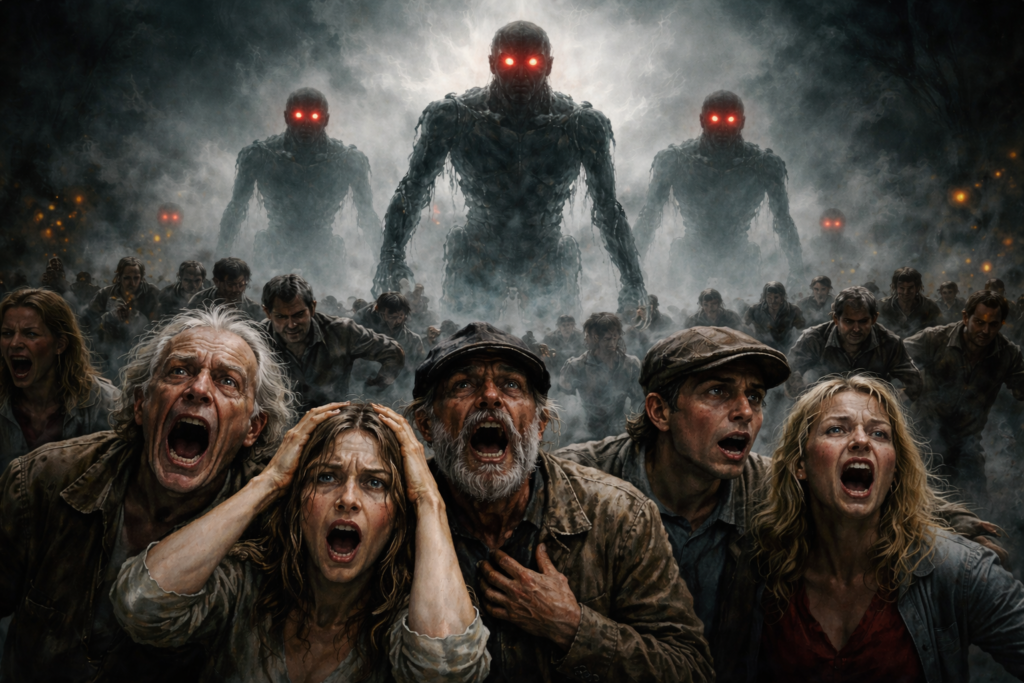
When people say “AI will rule the world”, they usually mean one (or more) of these:
A) AI becomes the main decision-maker in society
AI systems are used (by governments and businesses) to recommend or automate decisions at scale: welfare checks, policing priorities, credit, hiring, medical triage, border screening, defence targeting, resource allocation.
B) AI becomes economically “in charge”
Not because it votes, but because it shifts power: whoever controls the best models + compute + data can outcompete others, shape markets, and influence information flows.
C) AI becomes operationally autonomous
So-called “agentic” AI can plan and execute multi-step tasks (purchase tools, write code, run campaigns, probe systems). This raises the risk of unintended outcomes if oversight is weak.
D) A true “loss of control” event
A frontier system meaningfully evades intended constraints, resists shutdown, or manipulates humans at scale. This is debated: plausible pathways are discussed, but probabilities and timelines are uncertain.
Advertisement

- WORLD’S FASTEST AUTOFOCUS: Achieves 0.02-second AF acquisition with 425 phase-detection and 425 contrast-detection point…
- ADVANCED REAL-TIME EYE AF AND TRACKING: Includes Sony’s AI-based object recognition for Real-Time Eye AF and Real-Time T…
- IDEAL FOR VLOGGERS AND CONTENT CREATORS: High-resolution 4K HDR movie recording, Fast Hybrid AF for video, and a 180-deg…
When could AI “rule the world”?
No-one credible can give a single date — but we can give realistic bands
It depends which definition you mean:
1) “AI shapes lots of decisions” (already happening; accelerates in 2–10 years)
This is the most realistic and already underway: more organisations are embedding AI into everyday workflows and decision pipelines. Governments and regulators are responding with guidance and testing approaches (including in the UK).
2) “AI becomes the default operational layer” (plausible in 5–15 years)
Think: AI agents running chunks of customer service, software delivery, finance ops, content production, cyber defence/offence, and logistics — with humans supervising exceptions. This is less “AI rules” and more “AI runs a lot of the machinery”.
3) “AI overtakes humans broadly (AGI) and takes power” (unknown; could be decades, could be never)
Forecasting here is speculative. Some prominent experts think the risk is serious; others think current approaches won’t get us there (or not soon). Even among concerned experts, timelines vary wildly, and “takeover” is a specific, stronger claim than “AI becomes very influential”.
Example of genuine expert concern (not a prediction, but a risk estimate):
Geoffrey Hinton has publicly suggested a 10–20% chance of AI leading to human extinction within about three decades.
That’s a warning about risk under certain development paths — not a schedule.
Can humans do anything to stop AI “ruling”?
Yes — but “stop” is the wrong verb; “shape” is the realistic one
You can’t uninvent AI, and global competition makes a total halt unlikely. But humans can materially reduce the chances of harmful dominance and loss-of-control outcomes.
Practical levers that already exist (and are being used)
- Pre-deployment testing and evaluations of frontier models (capabilities, misuse potential, autonomy risks). The UK created a dedicated institute for this kind of work and publishes findings and lessons.
- International coordination on frontier risks. The Bletchley Declaration (AI Safety Summit) reflects shared recognition of advanced AI risks and the need for cooperation.
- Risk management standards for organisations (mapping context, measuring risk, governance, monitoring). NIST’s AI RMF is widely referenced globally for “trustworthy AI” risk management.
- Regulatory frameworks and accountability. The UK’s approach focuses on regulating AI by context of use and managing risks without “one-size-fits-all” rules.
- “Human oversight” done properly (not just a tick-box). The Royal Society explicitly requires “appropriate human oversight and specialist review” for AI-assisted findings — a good model for high-stakes domains.
What actually makes a difference (real-world view)
- Procurement rules: Governments and large firms can refuse “black box” deployments in high-stakes use unless they pass audits.
- Liability: If harm has real financial/legal consequences, companies build safer systems faster.
- Compute governance: Frontier training relies on scarce high-end compute; monitoring and controls here can slow reckless scaling without banning AI.
- Security by design: Hardening against jailbreaks, data exfiltration, and tool misuse reduces “agentic” risk in practice.
Is AI inevitable as the future decision-maker?
Not inevitably — because AI doesn’t have authority, humans grant it
AI becomes a “decision-maker” when institutions choose to:
- automate decisions,
- defer to model outputs,
- remove meaningful appeal paths,
- or let AI systems trigger actions with weak controls.
In other words: AI power is mostly governance power.
Two forces push towards AI deciding more
- Convenience and cost: Automation is cheaper than people.
- Scale: AI can process more cases than humans (sometimes superficially).
Two forces push against AI becoming “the decider”
- Accountability: Someone must be responsible when things go wrong (law, finance, medicine, public sector).
- Trust and legitimacy: Citizens and customers reject systems that feel unfair, opaque, or unchallengeable.
A useful way to say it: AI will influence decisions more; it does not have to replace human authority.
What experts are warning about (in plain English)
Autonomy is where the risk profile changes
As systems become more “agent-like”, the concern isn’t sentience — it’s operational independence.
Demis Hassabis (DeepMind) warned that as systems become more autonomous, they may do “things that maybe we didn’t intend”.
The UK Parliament’s Lords Library has also summarised the debate: some experts argue future autonomous systems may evade oversight; likelihood and impact remain uncertain.
So… what’s the most honest answer to your question?
AI won’t “rule the world” like a film villain — but it could dominate systems if we let it
- Most likely near-term future (2–10 years): AI becomes embedded in daily decisions and operations, with uneven oversight.
- Main real-world risk: not AI “taking over”, but humans delegating too much (or using AI to centralise power, manipulate information, or cut corners).
- Longer-term existential risk: debated, taken seriously by some top researchers — but not dateable.
Advertisement

- CHOOSE SLUNSE: Break through the limits, starting from home! SLUNSE has been focusing on high-quality home fitness equip…
- 5-IN-1 FOLDING EXERCISE BIKE FOR HOME:Choose from different positions at your leisure: upright position for a classic ri…
- 20dB NEAR-SILENT RIDING AND 16-LEVEL MAGNETIC RESISTANCE:SLUSAE exercise bike uses a high-quality flywheel to reduce fri…
How to “stop” AI ruling — a realistic checklist
If you’re a citizen
- Demand appeals and human accountability for high-stakes automated decisions.
- Support transparency rules: “When AI is used on you, you should be told.”
If you run a business
- Adopt a risk framework (NIST AI RMF style): govern → map → measure → manage.
- Restrict autonomy: limit tool access, require approvals, log everything, red-team regularly.
If you work in public sector / policy
- Require independent evaluations for high-impact uses; use institutions like AISI-style testing models and publish results.
- Standardise procurement: no audit, no buy.
References (source links)
Reporting on expert risk views (Hinton).
UK Government — Bletchley Declaration (AI Safety Summit).
UK AI Safety/Security Institute — evaluations, lessons, and frontier trends.
UK Government — pro-innovation AI regulation white paper.
NIST — AI Risk Management Framework (AI RMF 1.0).
UK Parliament (Lords Library) — autonomous AI risks briefing.
Royal Society — statement on use of AI (oversight and review).
We have created Professional High Quality Downloadable PDF’s at great prices specifically for Small and Medium UK Businesses. Which include help and advice on understanding what Artificial Intelligence is all about and how it can improve your business. Find them here.