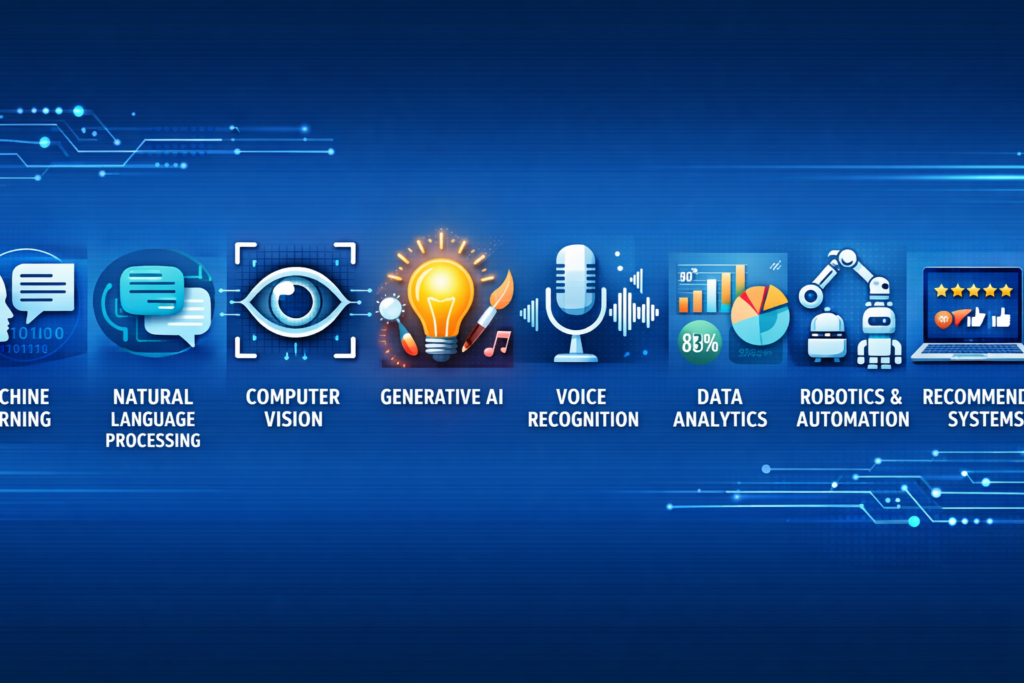
Edge AI (Artificial Intelligence at the “edge”) means running AI algorithms directly on local devices — such as smartphones, cameras, sensors, vehicles, or IoT systems — rather than sending data back to a cloud‑based server for processing.
The “edge” refers to the edge of the network, where data is generated.
In short:
- Traditional AI = data sent to a central data centre for analysis.
- Edge AI = analysis done right where the data originates.
It’s the difference between asking a distant supercomputer for an answer, versus teaching your local device to think for itself in real time.
How Does Edge AI Work?
Local Data Processing
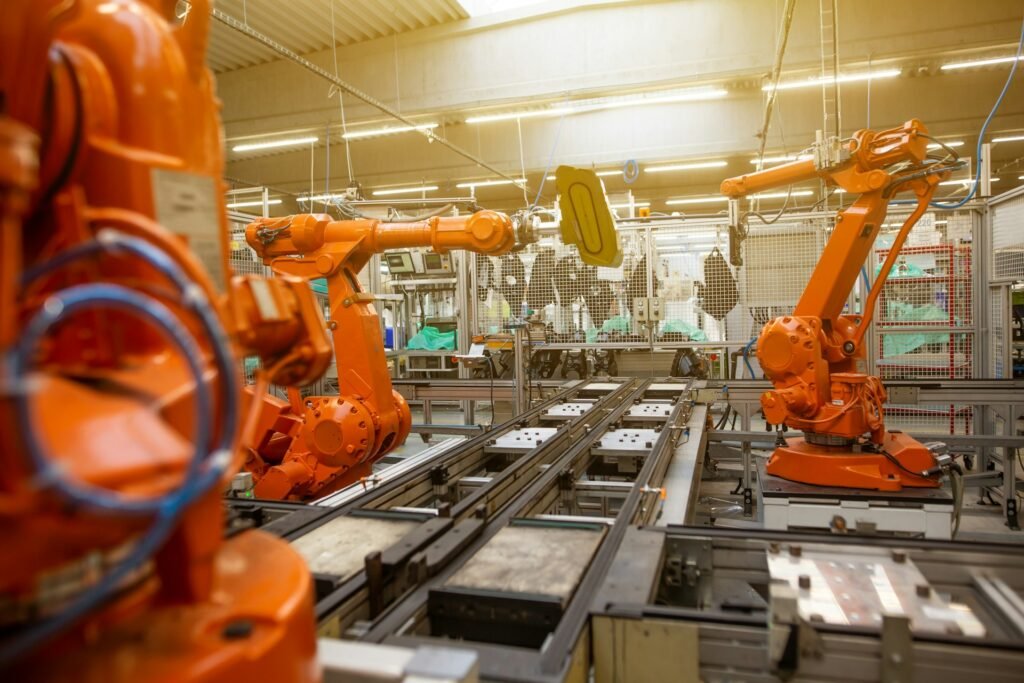
Edge devices — such as industrial robots, autonomous vehicles or security cameras — contain compact AI chips or neural‑network processors capable of analysing data on site.
These chips use embedded machine‑learning models trained in advance on powerful cloud computers but then downloaded to the device itself. Once deployed, the edge device:
- Captures data (sound, image, motion, temperature, etc.).
- Processes it locally using the onboard AI model.
- Makes a decision instantly — without waiting for a cloud connection.
Learning and Updating
While real‑time decision‑making happens on the device, updates to the model (for example, improved recognition accuracy) are still distributed from central servers periodically.
This hybrid structure allows continual improvement without constant dependence on the internet.
Example
A CCTV system in London may use edge AI to detect unusual movement patterns in a crowd. Instead of streaming video to a data centre (which is slow and expensive), the camera analyses footage locally. Only alerts or relevant frames are sent to a control room.
That immediate analysis dramatically reduces latency and network traffic — ideal for time‑sensitive scenarios like policing, factory control or autonomous driving.
Who Uses Edge AI and Why?
Industry and Manufacturing
Factories across the UK and Europe are heavy adopters of edge AI.
Companies like Rolls‑Royce, Jaguar Land Rover, and Siemens UK deploy local AI sensors to monitor machinery, detect vibration anomalies and predict component failures.
This approach prevents downtime without storing terabytes of unnecessary operational data.
“Edge computing gives machines the kind of situational awareness humans take for granted,” says Dr. Haydn Thompson, Director of the UK Smart Systems Group. “It lets them act before a problem becomes visible.”

Healthcare
Hospitals use edge AI in patient monitoring systems — for example, medical imaging equipment that detects early signs of stroke or tumour locally before test results are uploaded.
Quicker diagnosis can improve survival rates and reduce the burden on radiologists.
Autonomous Vehicles and Transport
Edge AI drives real‑time decision‑making in self‑driving cars, drones and smart traffic networks.
AI cameras on board decide whether to brake, steer or identify a hazard in milliseconds — something impossible if waiting for data‑centre feedback.
The UK Connected and Automated Mobility (CAM) programme relies heavily on this structure for autonomous vehicle testing in Oxfordshire and Milton Keynes.
Retail and Smart Cities
In retail, edge AI helps track customer flow, automate checkout systems and optimise energy use (smart lighting, heating and ventilation).
In smart city management, it supports public safety, waste management and traffic optimisation — without violating privacy laws by sending every scrap of data to a central server.
Benefits of Edge AI Over Standard (Cloud‑Based) AI
1. Speed and Latency
Edge AI processes data locally, eliminating network lag. In areas such as healthcare, autonomous vehicles or industrial control, every millisecond counts.
As Professor Neil Lawrence (University of Cambridge, AI researcher) notes:
“Latency may sound technical, but in AI it’s the line between smooth automation and catastrophic error.”
2. Privacy and Security
Data stays on the device unless absolutely necessary. This minimises exposure to cyber‑attacks and complies with stricter privacy laws, including the UK Data Protection Act 2018 and GDPR.
For instance, voice assistants that analyse speech locally avoid storing sensitive recordings on corporate servers.
3. Lower Bandwidth Costs
Since edge devices transmit less raw data, users save significant bandwidth. Telecom networks benefit too, as the load on 5G infrastructures reduces.
4. Reliability
If an internet or power outage occurs, edge AI devices continue functioning independently. This resilience is vital for emergency services, maritime systems, and rural industries.
5. Energy Efficiency
Ironically, even though more chips are distributed in the field, the total energy use can decrease because large‑scale data transfers and central server cooling decline.
The Energy Systems Catapult projects that decentralised AI systems may reduce total data‑centre energy consumption by 12–15% by 2035.
6. Scalability
Because each device handles its own data, edge networks scale easily. The more sensors you add, the more distributed intelligence exists, rather than one central point of failure.
Drawbacks and Challenges
Hardware Cost and Maintenance
Edge AI requires sophisticated local hardware (AI chips, power‑efficient processors). Upgrading thousands of devices is costly and technically complex.
Limited Computing Power
While efficient for immediate analysis, edge devices cannot yet handle deep learning retraining. They depend on periodic model refreshes from the cloud.
Security Responsibility
Keeping data local protects privacy but also means security responsibility shifts to the edge. Each device must be properly managed, patched and monitored. If not, cyber‑risks multiply.
Is Edge AI the Future — or Just a Step in Technology?
A Transitional Yet Strategic Evolution
Edge AI is more than a fad — but it’s also not the “end state” of digital intelligence.
It represents a necessary evolution towards distributed, hybrid systems, where the cloud and edge work together.
Dr. Andrew Tyrer, Head of Robotics and AI at Innovate UK, summarises it neatly:
“Edge computing is the bridge between central intelligence and everyday practicality. It’s what makes AI usable in the wild, not just in theory.”
Why Edge AI Is Essential for the UK
With the UK’s current focus on smart transport, renewable grids, and autonomous logistics, edge AI provides:
- Faster local decision making for safety‑critical systems.
- Reduced dependency on foreign cloud services (a strategic security advantage).
- Lower carbon footprint from reduced data centre demand.
Beyond Edge: The Next Step
Over the next two decades, the likely direction will be “Federated AI” — a step beyond edge computing where independent AI devices collaborate securely via encrypted learning exchanges.
This allows systems to learn collectively without sharing raw data. The model is already being trialled in NHS digital diagnostics to allow hospitals to share AI improvements while keeping patient data local.
In this sense, Edge AI is a crucial milestone — not the final destination, but the practical groundwork for future decentralised intelligence.
Real‑World Use Cases in the UK
| Sector | Example | AI Role | Real Impact |
|---|---|---|---|
| Manufacturing | Rolls‑Royce & Siemens | Predictive maintenance | Downtime reduced by 15% |
| Healthcare | NHS AI scanner trials | Real‑time patient triage | Faster diagnosis, fewer errors |
| Smart Cities | TfL & local councils | Edge traffic sensors | Reduced congestion by up to 10% |
| Retail | Tesco AI shelf monitors | On‑site stock tracking | Improved logistics, reduced waste |
| Agriculture | Arable & Agri‑Tech UK | Soil & moisture sensing | Up to 12% less water and fertiliser use |
References (UK‑Focused)
- Innovate UK – Edge Computing and AI Strategy Report (2025)
- National Grid & Energy Systems Catapult – AI and Edge Infrastructure in Smart Networks (2024)
- University of Cambridge – Professor Neil Lawrence, Faculty of Computer Science, Public Lectures (2025)
- NHS Digital – Federated Learning Pilot Programme (2025)
- Department for Science, Innovation and Technology (DSIT) – UK AI Roadmap Update (2026)
Summary
| Aspect | Traditional AI (Cloud-Based) | Edge AI |
|---|---|---|
| Data Processing Location | Central servers/data centres | Local on-device |
| Speed & Latency | Slower, network-dependent | Real-time, minimal lag |
| Privacy & Security | High data exposure | Local protection of personal data |
| Energy Efficiency | High data transfer and cooling costs | Lower overhead, less transmission |
| Reliability | Needs constant connectivity | Operates offline if needed |
| Scalability | Central bottleneck | Distributed and flexible |
In conclusion:
Edge AI is not a gimmick — it’s the next logical extension of modern computing. It brings intelligence closer to where life happens: in cars, homes, hospitals and factories.
While it may eventually evolve into more collaborative “federated” forms, in the coming decade Edge AI will be the backbone of practical, sustainable and privacy‑aware automation across the UK economy.
Or, to put it simply: AI in the cloud thinks — Edge AI reacts. And in the real world, reaction speed is everything.