
Artificial Intelligence (AI) requires an enormous amount of data to be processed simultaneously — far more than standard computers can handle efficiently.
To meet this demand, technology firms have created specialised microchips designed specifically for machine learning, neural networks and large data computation.
These chips are the hardware backbone of modern AI systems — powering everything from ChatGPT‑style models to driverless cars and industrial robotics.
The Main Types of AI Chips
1. GPUs – Graphics Processing Units
- Original Purpose: Designed for rendering graphics in gaming and multimedia.
- AI Role: GPUs (made by companies such as NVIDIA and AMD) are superb at handling many small calculations at once — known as parallel processing.
- Advantage: Ideal for training machine learning models that require analysing massive datasets simultaneously.
Example: NVIDIA’s H100 Tensor Core GPU (2024) can perform up to 60 teraflops (trillion floating‑point operations per second), thousands of times more parallel calculations than a typical laptop CPU.
2. TPUs – Tensor Processing Units
- Developed by Google, TPUs are purpose‑built ASICs (Application‑Specific Integrated Circuits) for deep learning.
- Designed to accelerate “tensor” operations used in neural networks — calculations where values are stored and manipulated in multi‑dimensional arrays.
- Advantage: High efficiency at lower power consumption compared to GPUs for specific AI tasks like speech recognition and image classification.
Google estimates a single TPU pod (a rack of connected TPUs) can deliver exaflop‑level performance — that’s one quintillion (10¹⁸) operations per second.
3. NPUs – Neural Processing Units
- Used in edge devices (phones, laptops, and IoT systems) to perform smaller AI tasks locally instead of sending data to cloud servers.
- Apple, Samsung and ARM (UK) are developing NPUs to operate generative AI features directly on devices.
- Advantage: Quicker responses and improved privacy by reducing cloud dependence.
Example: Apple’s A17 Pro chip in recent iPhones delivers up to 35 trillion operations per second (TOPS) in AI inference power — 10x faster than earlier mobile chips.
Advertisement

- 【23.8-inch All‑in‑One PC with Core i5‑7300】Responsive everyday performance — 16GB RAM + 512GB SSD deliver fast boot, smo…
- 【Modern Connectivity & Fast Networking】Built‑in Wi‑Fi 6 and Bluetooth 5.3 ensure stable wireless connections; full I/O i…
- 【Space‑Saving, Ready‑to‑use All‑in‑One PC】Compact all‑in‑one form factor with included keyboard and mouse makes setup si…
4. IPUs – Intelligence Processing Units
- A British innovation developed by Graphcore, based in Bristol.
- Unlike GPUs (which execute instructions sequentially), IPUs are designed to think natively in graphs, similar to how neural networks operate.
- Advantage: Handles highly interconnected data far more naturally, excelling in advanced AI training and inference.
Graphcore’s latest Bow IPU (2024) can handle 350 trillion operations per second while using significantly less energy than GPU equivalents.
5. FPGAs – Field‑Programmable Gate Arrays
- Flexible hardware chips that can be custom‑programmed post‑manufacture to execute specific computational tasks.
- Used in bespoke AI deployments such as telecoms, aerospace, or high‑frequency trading.
They combine versatility with energy efficiency, though they’re more complex to reconfigure and not as fast as GPUs or TPUs for large‑scale model training.
What Makes AI Chips Different from Normal PC Processors
Parallelism and Throughput
An average laptop CPU (central processing unit) might have 8 to 16 cores optimised for sequential general‑purpose tasks like word processing, browsing or spreadsheets.
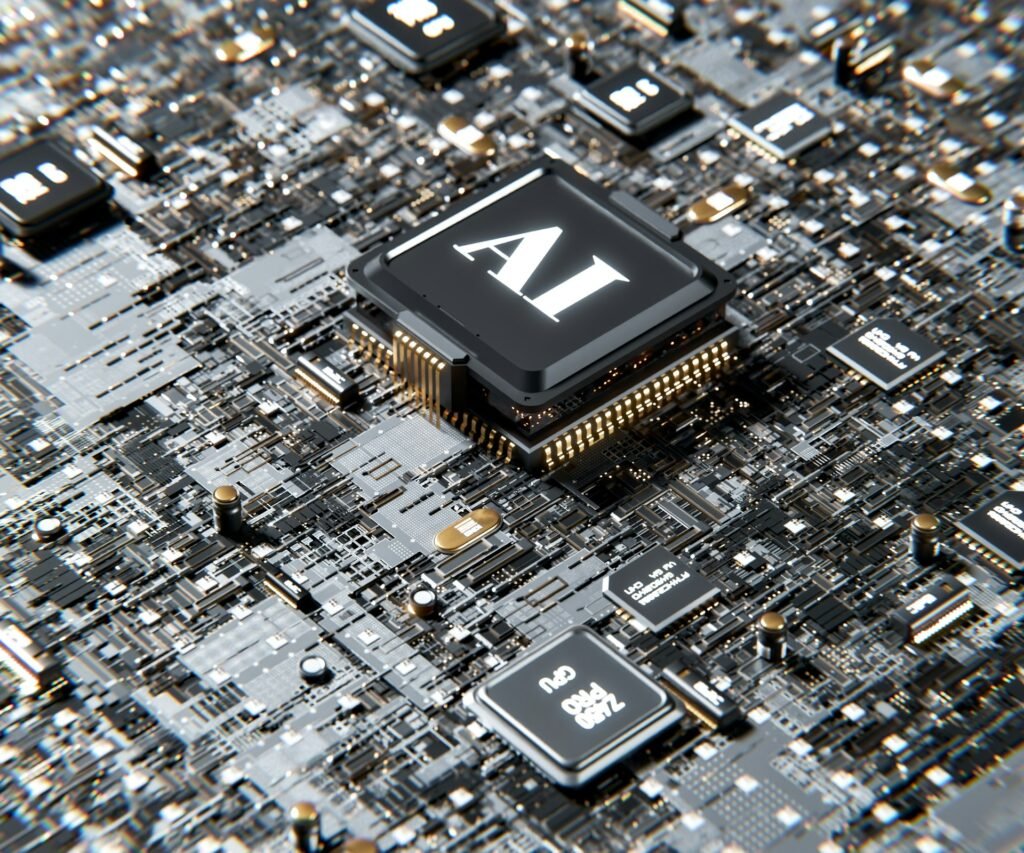
An AI chip like a GPU or IPU can have thousands of cores engineered to run computations simultaneously.
As Dr Bob Rees, director of digital innovation at NVIDIA (UK), puts it:
“A CPU is like a diligent office worker doing one job at a time. An AI chip is a stadium full of workers handling thousands of related jobs at once.”
Specialised Architecture
AI chips are designed around the maths of neural networks — primarily matrix multiplication and tensor computation.
This means their logic circuits, memory and cache systems are optimised not for variety, but for repeating small calculations incredibly fast.
In simple terms, they are built to recognise patterns, whereas laptop CPUs are built to process instructions.
On‑Chip Memory and Bandwidth
AI chips often have high‑bandwidth memory (HBM) that can feed vast amounts of data to processors without bottlenecking performance.
A laptop CPU handles maybe 50–100 GB/s of data bandwidth, while AI GPUs can exceed 2 terabytes per second (2,000 GB/s).
This allows large AI models to process imagery, speech or data streams in near real‑time — something desktop processors could never manage efficiently.
Power and Efficiency
AI chips use advanced designs like systolic arrays, allowing millions of simultaneous arithmetic operations per clock cycle.
Because of this — even though energy per chip is high — they deliver far more performance for each watt used.
For perspective, a consumer laptop CPU might use 45 watts, producing tens of gigaflops.
A data‑centre AI GPU uses 350–400 watts, but produces tens of thousands of gigaflops — around 1,000× higher computational throughput per watt.
How Powerful Are AI Chips Compared to a Home Laptop?
| Comparison Metric | Average Home Laptop (Intel i7 / Apple M2) | Modern AI Chip (NVIDIA H100 / Graphcore Bow IPU) |
|---|---|---|
| Processing Cores | 8–16 | 10,000+ equivalent compute units |
| Power Draw | 45–65 W | 350–600 W (per chip) |
| Peak Performance | Around 1 teraflop | 60 – 350 teraflops |
| Data Bandwidth | 50–100 GB/s | 1,500–2,000 GB/s |
| Specialisation | General computing | Parallel AI and tensor maths |
| Cost (2025) | £1,000–£2,000 | £25,000–£40,000 each (data‑centre grade) |
In other words, an AI chip is not just stronger — it lives in an entirely different performance universe.
A single high‑end GPU powering AI computations might match the output of hundreds of typical laptops running in parallel.

Real‑World Applications in the UK
Healthcare
AI chips deployed in NHS imaging diagnostics allow rapid analysis of MRI and CT scans. Systems powered by NVIDIA GPUs have cut report turnaround times from hours to under ten minutes, improving patient outcomes.
Financial Services
London‑based trading firms run FPGA and GPU clusters to detect fraud or optimise stock strategies in real time — operations 100× faster than with CPU‑only setups.
Automotive and Energy
British electric vehicle companies and National Grid are using AI chips to interpret massive sensor data feeds and forecast energy flows within milliseconds.
These sectors rely on AI accelerators because mistake‑free real‑time decisions require speed and predictive reliability far beyond laptop‑class computing.
Expert and Industry Perspectives
Professor Mike Wooldridge, Director of AI Research at the Alan Turing Institute, explains:
“AI applications now outstrip conventional computing by several orders of complexity. Without purpose‑built chips, even the most powerful CPU systems would struggle to replicate what one rack of accelerators can do in a tenth of the time.”
Meanwhile, Nigel Toon, CEO of Graphcore (Bristol), told the Financial Times (2025):
“The future of AI hardware isn’t just power — it’s efficiency. The real race is who can deliver the most intelligence per watt, and that’s where dedicated UK innovation will shine.”
Advertisement

- More Room to Make Big Plays: A compact, space-saving layout designed to give players more room for sweeping mouse moveme…
- Eight Zone RGB Backlighting: Create personalised lighting as dazzling as your clutch plays with 8 zones of brilliant RGB…
- 300ml Spill Resistance: K55 CORE TKL is built for gaming and built to stand up to the perils of daily life. Don’t let a …
A Real‑World View
AI chips are extraordinary in capability but not replacements for standard computing — they’re highly specialised tools.
They’re vital for training and running large AI models, handling workloads measured in petabytes, but for ordinary users they’re unnecessary (and absurdly expensive).
Realistically, high‑end laptops will increasingly use smaller, on‑device NPUs to bring some of this AI acceleration locally (e.g. language assistants or image editing).
Meanwhile, the big “thinking work” — model training, national data management, and enterprise analytics — will continue happening on vast AI chip clusters housed in remote data centres.
References (UK‑Focused and Global)
- The Alan Turing Institute – Artificial Intelligence Hardware Landscape, 2025
- Graphcore (Bristol) – Bow IPU Technical White Paper, 2024
- National Grid ESO – AI Computational Forecasting Report, 2025
- Financial Times – The UK’s AI Chip Ambitions, July 2025
- University of Cambridge Computer Laboratory – AI Hardware Efficiency Study, 2025
- NVIDIA UK – AI Accelerated Computing Overview, 2024
Summary
| Key Point | Explanation | Real‑World Implication |
|---|---|---|
| Specialised chips | GPUs, TPUs, NPUs, IPUs and FPGAs built for neural network maths | Enable modern AI systems to train and predict effectively |
| Key difference | Massive parallel processing of trillions of small calculations | Orders of magnitude faster than CPUs |
| Power | Hundreds to thousands of times faster than laptop processors | Enables real-time vision, speech, and analytics |
| Cost and context | Expensive, industrial hardware | Deployed in data centres and research labs, not households |
In conclusion:
Specialised AI chips are the engines of the intelligence age. They process information not line by line, but in vast parallel waves, replicating neural logic at lightning speed.
While a home laptop handles emails and browsing, an AI GPU or IPU can simulate human language, forecast energy grids, and analyse medical scans — thousands of times faster and more intelligently.
In short, AI chips are not computers as we know them — they’re turbo‑brains built purely for thought.