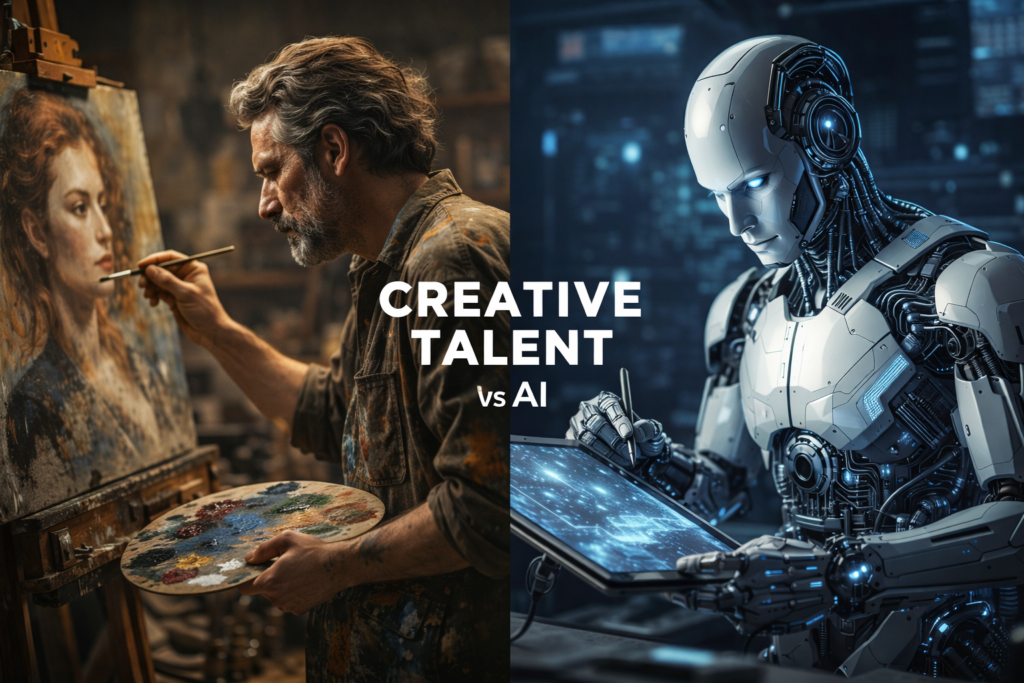
If you run a marketing agency in Britain, this is where the AI impact gets uncomfortable.
Unlike cyber or law, marketing contains a large amount of repeatable, automatable work.
That makes it one of the most exposed sectors.
The Number You Actually Want
There is no official UK statistic that isolates “AI-caused failures”.
But using:
- UK business closure rates from the Office for National Statistics
- Insolvency data from the Insolvency Service
- Adoption trends in AI tools across SMEs
A realistic 10-year estimate is:
12%–30% of current UK marketing agencies could close where AI-driven disruption is a major contributing factor.
That’s higher than cyber. Higher than most professional services.
Why?
Because AI directly automates the product.

Why Marketing Is Structurally Exposed
1. AI Writes, Designs and Plans
AI now produces:
- Blog posts
- Ad copy
- Email campaigns
- SEO outlines
- Social media calendars
- Product descriptions
- Basic graphic design
- Paid ad variants at scale
If your agency model is built on:
- junior content writers
- templated SEO packages
- manual campaign reporting
- hourly billing for copy
Margins compress fast.
Clients ask:
“Why am I paying £2,000 a month for something software can draft in seconds?”
Advertisement

- WORLD’S FASTEST AUTOFOCUS: Achieves 0.02-second AF acquisition with 425 phase-detection and 425 contrast-detection point…
- ADVANCED REAL-TIME EYE AF AND TRACKING: Includes Sony’s AI-based object recognition for Real-Time Eye AF and Real-Time T…
- IDEAL FOR VLOGGERS AND CONTENT CREATORS: High-resolution 4K HDR movie recording, Fast Hybrid AF for video, and a 180-deg…
2. Platforms Are Embedding AI Natively
Marketing tools are not waiting for agencies.
Platforms like:
- Meta
- HubSpot
are embedding AI optimisation, targeting, creative suggestions and automated reporting directly into their ecosystems.
That removes a layer of “middle” work agencies used to monetise.
The CMA has warned about concentration risks in AI markets — large incumbents gain disproportionate advantage.
Source: Competition and Markets Authority
Translation: scale wins.
3. Clients Expect More for Less
Once AI speeds up delivery:
- Turnaround times shrink.
- Output volume increases.
- Personalisation becomes standard.
- Reporting must be instant.
Fees rarely rise to compensate.
Agencies competing on cost suffer most.

Where the 12%–30% Estimate Comes From
Step 1: Baseline UK business churn
ONS business demography data shows annual business “death rates” near 10% in recent years (all sectors).
Source: Office for National Statistics
That’s normal turnover before AI pressure.
Step 2: Marketing has high “automation density”
Marketing includes many processes AI compresses by 30–70%:
- Research
- Copy drafting
- Variant testing
- Reporting
- Data summarisation
- Audience segmentation
Few other sectors have such a high proportion of automatable tasks.
Step 3: Barrier to entry drops
A solo operator with AI tools can now:
- Produce agency-level output.
- Run multi-channel campaigns.
- Build branding decks.
- Generate video scripts.
That increases competition dramatically.
More suppliers + lower pricing power = higher failure rate.
Advertisement

- BUILT FOR APPLE INTELLIGENCE — Apple Intelligence is the personal intelligence system that helps you write, express your…
- TAKE TOTAL CAMERA CONTROL — Camera Control gives you an easier way to quickly access camera tools, like zoom or depth of…
- GET CLOSER AND FURTHER — The improved Ultra Wide camera with autofocus takes incredibly sharp, detailed macro photos and…
Who Is Most at Risk?
High Risk (AI directly replaces labour)
- Generic SEO agencies
- Content mills
- Social media scheduling agencies
- PPC managers who only optimise bids
- Agencies billing mainly for production hours
If your differentiation is speed or volume, AI eats that first.
Medium Risk
- Mid-sized full-service agencies without strong brand positioning
- Agencies reliant on platform arbitrage (e.g., “we know the Facebook algorithm”)
They survive only if they move up the value chain.
Lower Risk
- High-end brand strategy firms
- Creative agencies with genuine conceptual strength
- Specialist sector agencies (regulated industries)
- Agencies with proprietary data insights
AI enhances creative exploration — but it doesn’t replace accountability and judgement at the board level.
The Cynical Truth
AI won’t eliminate marketing.
It will:
- Reduce headcount growth.
- Kill junior-heavy delivery models.
- Collapse the value of undifferentiated content.
- Drive consolidation.
- Reward agencies that productise expertise.
Large consultancies and platform-native firms absorb gains.
Small agencies without a niche disappear quietly.

What I’d Do If I Ran a UK Marketing Agency
- Use AI aggressively internally before competitors do.
- Stop selling “content” — sell outcomes and revenue impact.
- Develop proprietary frameworks.
- Build a recognisable niche.
- Reduce reliance on junior copy production.
- Invest in strategy capability clients cannot automate.
My 10-Year Forecast (UK Marketing Sector)
- 12% failure if AI mainly boosts productivity across all agencies.
- 18–22% failure if mid-tier commoditisation accelerates.
- 25–30% failure if platforms absorb most execution-layer work.
But the sector’s revenue will likely grow overall.
The survivors will be fewer — but stronger.
References (UK Primary Sources)
- Office for National Statistics – UK business demography
- Insolvency Service – Company insolvency data
- Competition and Markets Authority – AI market concentration concerns
We have created Professional High Quality Downloadable PDF’s at great prices specifically for Small and Medium UK Businesses. Which include help and advice on understanding what Artificial Intelligence is all about and how it can improve your business. Find them here.