A hard question — and an honest answer
Artificial intelligence can now generate logos, write copy, edit photographs and mock up websites in seconds. For creative freelancers across England, that reality is no longer theoretical.
So the blunt question is this:
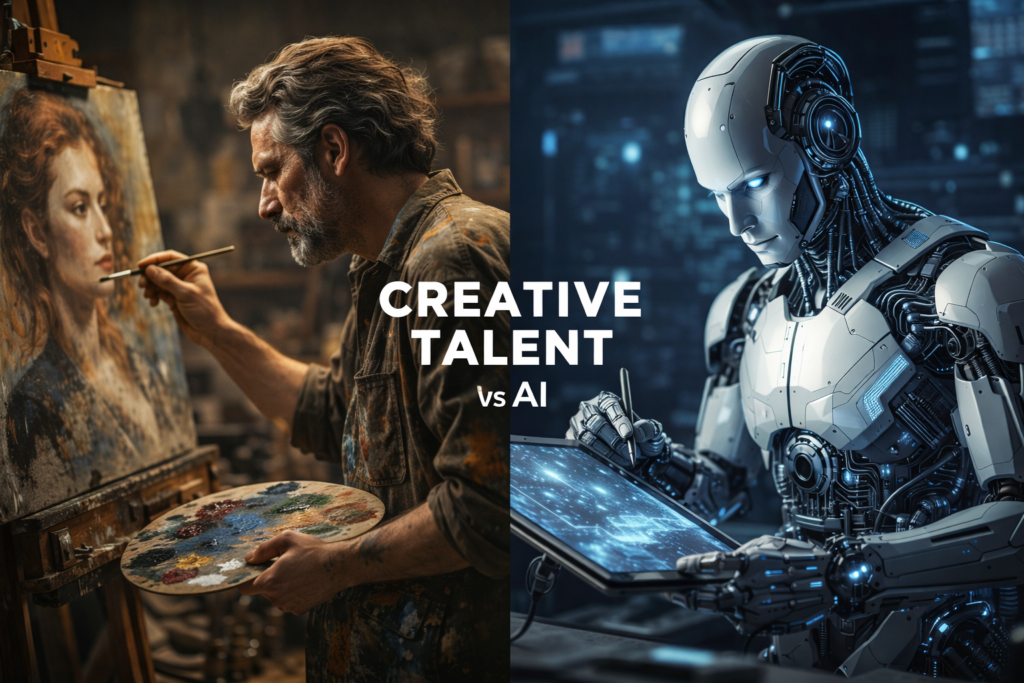
Can human creative freelancers compete long term — or are they slowly being automated out of the market?
The short answer: yes, but not in the way many expect.
The longer answer requires looking at economics, behaviour, regulation and what clients actually pay for.
The Economic Reality: “Good Enough” Just Got Cheaper
AI has dramatically reduced the cost of acceptable creative output. Tools embedded in platforms such as Adobe and Figma automate layout, image clean-up and content variation.
For SMEs under cost pressure, this is attractive.
The effect is predictable:
- Entry-level creative tasks become commoditised
- Turnaround expectations accelerate
- Clients question traditional pricing models
This does not eliminate demand. It compresses margins for routine work.
Freelancers competing purely on execution — resizing graphics, producing standard layouts — will find sustained downward pressure.
What AI Still Cannot Do (Reliably)
AI can remix patterns. It cannot genuinely understand:
- Brand nuance built over years
- Cultural context within English regional markets
- Local audience behaviour
- Strategic positioning
- Emotional subtext in storytelling
The Design Council consistently frames design as a driver of business performance, not mere aesthetics.
Source: https://www.designcouncil.org.uk/our-work/design-economy/
That distinction matters. Strategy remains human-led.
The Legal and Copyright Question Is Not Settled

The UK government has issued progress updates on copyright and AI, acknowledging ongoing consultation and unresolved issues.
Source: https://www.gov.uk/government/publications/copyright-and-artificial-intelligence-progress-report
The House of Lords has also examined AI’s implications for creative industries.
Source: https://lordslibrary.parliament.uk/copyright-and-artificial-intelligence-impact-on-creative-industries/
For clients concerned about intellectual property risk, a professional freelancer offering:
- Clear contracts
- Documented provenance
- Licensed imagery
- Accountability
…provides reassurance that a generative tool alone cannot.
Regulatory uncertainty may paradoxically protect professionals.
The Market Is Splitting in Two
Long term, the creative economy appears to be dividing:
Tier One: Commodity Production
Fast, automated, template-driven.
Low cost.
Low differentiation.
Tier Two: Distinctive Brand Building
Strategic positioning.
Original photography.
Thoughtful typography.
Campaign-level creative.
Audience insight.
Freelancers who operate in Tier One face structural pressure.
Freelancers who move into Tier Two compete on thinking, not speed.
The Human Advantage: Trust and Accountability

SMEs do not simply buy design files.
They buy:
- Confidence
- Clarity
- Interpretation
- Advice
- Accountability
If a campaign fails, an AI tool cannot explain why or adjust strategy in context.
A freelancer can.
In uncertain economic conditions, trust has commercial value.
The Brutal Truth: Some Roles Will Shrink
It would be naïve to pretend otherwise.
Long term:
- Basic logo generation
- Social media resizing
- Entry-level layout work
- Simple copy drafts
…are unlikely to command the same fees.
Freelancers who refuse to adapt risk erosion of income.
The Strategic Adaptation Path
Creative freelancers in England who want longevity should consider:
1. AI Fluency
Use AI to speed workflow — not compete with it.
2. Sector Specialisation
Deep knowledge of a niche (weddings, trades, hospitality, tech start-ups) is difficult to automate.
3. Commercial Literacy
Understand margins, conversions and customer journeys.
4. Retainer Models
Ongoing advisory roles offer stability beyond project-by-project billing.
5. Accessibility and Compliance Knowledge
Understanding standards such as WCAG 2.2 — maintained by the World Wide Web Consortium — can differentiate services.
Source: https://www.w3.org/TR/WCAG22/
Will AI Replace Creative Freelancers Entirely?
Highly unlikely.
AI lacks:
- Legal accountability
- Ethical judgement
- Emotional lived experience
- Regional cultural understanding
- Relationship-building ability
However, AI will likely:
- Reduce the number of low-skill creative roles
- Increase expectations for speed
- Compress entry-level pricing
The profession will not disappear.
It will narrow and professionalise.
The Long-Term Outlook
England’s SME economy still needs:
- Distinctive branding
- Clear communication
- Digital visibility
- Trust signals
Design remains central to those needs.
The freelancers who survive long term will not be the fastest producers of files.
They will be the clearest thinkers.
AI is not the end of English creative freelancing.
It is the end of creative complacency.
Find Help and Support
We have created Professional High Quality Downloadable PDF’s at great prices specifically for AI businesses in the UK. Which include help and advice on understanding what Artificial Intelligence is all about and how it can improve your business. Find them here.