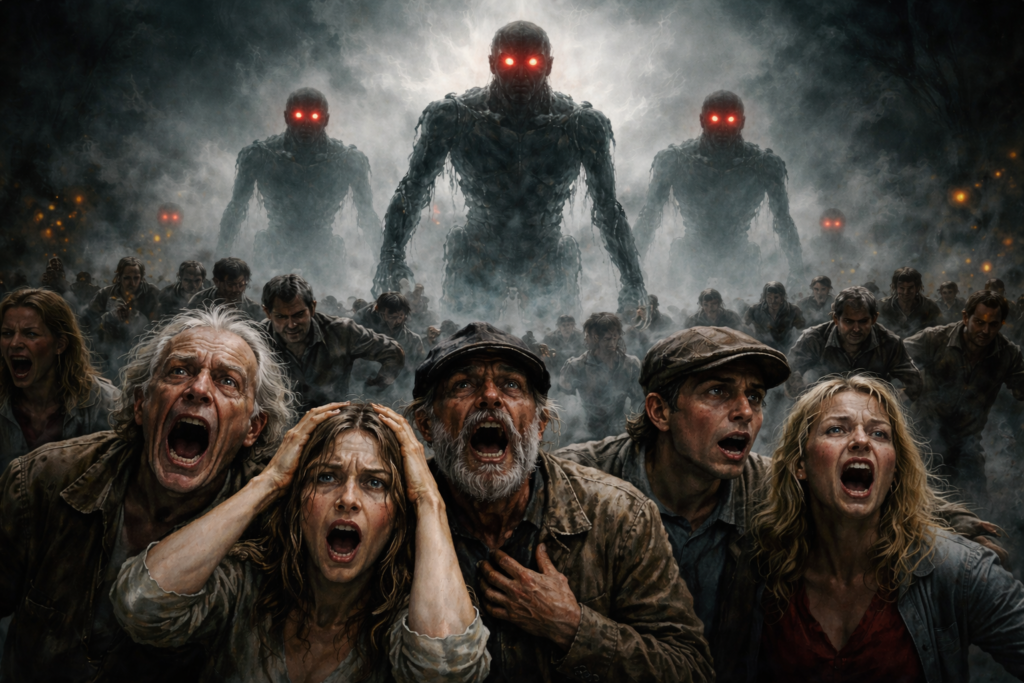
Artificial Intelligence is transforming life faster than the public can keep up — from workplaces to healthcare, from finance to everyday conversation. Yet, beneath the glossy political speeches and breathless tech headlines, for millions of ordinary Britons, the rise of AI provokes anxiety, mistrust and mental fatigue.
The uncomfortable truth is this: for all its promise, AI could become more of a psychological burden than a breakthrough, particularly for those who feel alienated by change or powerless to influence it.
A Nation Overloaded: When Progress Feels Like Pressure
Information Fatigue and the ‘Digital Divide’
AI amplifies the digital divide. Younger and tech‑savvy Britons may adjust easily, but many others find themselves shut out by complexity and jargon.
A 2025 poll by YouGov found that 62% of UK adults said they “don’t fully understand how AI works”, and a third admitted they “actively avoid learning about it.”
Dr. Helena Cross, a digital psychology specialist at the University of Sheffield, told BBC News:
“We’ve reached a point where people feel they’re supposed to trust systems they don’t comprehend. That disconnect creates cognitive stress — a sense of permanent uncertainty.”
This isn’t just a learning problem; it’s an emotional one. Every time a bank chatbot, workplace algorithm or app update behaves unpredictably, it undermines confidence. For many, technology now feels not empowering but imposed.
AI at Work: Efficiency Meets Exhaustion
Automation Anxiety
AI is supposed to make jobs easier — yet for countless British workers, it’s doing the opposite. A report by the Chartered Institute of Personnel and Development (CIPD, 2025) warned that one in five employees say “AI monitoring” (tracking productivity, keystrokes, tone of emails or even voice patterns) has made work more stressful.
Automation isn’t eliminating drudgery; it’s intensifying performance pressure. Algorithms don’t praise effort, only output.
Nigel Pell, a warehouse worker interviewed by The Guardian in late 2025, put it bluntly:
“We’re told the system’s watching for errors to help us improve. But really, it’s watching for when we slow down. It’s like having a boss you can’t talk to.”
For older employees unaccustomed to constant digital oversight, this amounts to workplace paranoia disguised as progress.
The Human Cost of Efficiency
Psychologists at King’s College London have begun linking algorithmic management to higher rates of sleep disruption and chronic anxiety. The pressure to adapt endlessly — to “upskill,” to engage with systems that never explain themselves — is triggering what they call technological exhaustion.
Professor Marina Hobbs explains:
“It’s not classic fear of automation; it’s fatigue. AI changes the rhythm of work, not just the tasks. You never feel finished because the system keeps evolving.”
Advertisement
- Effortless security anywhere: Install in seconds – magnetic, hanging, screwed or on a flat surface. Compact, wireless an…
- Always bright colours, even at night: Experience vivid images, even in low light. PureColor Vision gives clear night vis…
- Quick setup with centralized management: Connect and control your devices instantly with HomeBase Mini, your smart secur…
Social Media, Smart Homes and the Rise of the ‘Data Self’
When Everything Feels Like Surveillance
The average Briton already interacts with AI dozens of times per day — recommendation engines, smart speakers, filters and fraud detection — often unknowingly.
As these networks expand, so does the sensation of being constantly observed.
A 2025 report from Ofcom found that 70% of Britons worry their online data “is being used in ways they don’t understand,” a figure that jumped five points in just a year.
AI doesn’t simply learn what people like; it learns who they are — how fast they type, their mood, their sleep habits. While these systems promise personalisation, they often produce paranoia.
To quote The Times technology columnist Clara Mitchell (2025):
“AI is sold as a mirror to our needs, but it feels more like a microscope. It’s not comforting — it’s claustrophobic.”
The Psychological Impact of ‘Invisible Systems’
Unlike industrial revolutions of the past, AI isn’t visible. You can’t see the algorithm that decides your insurance premium or job interview outcome. That opacity fosters suspicion.
For older Britons and those less digitally literate, it triggers what experts call “latent mistrust” — the persistent worry that unseen mechanisms are quietly deciding their fate.

Public Trust and Mistrust: A Widening Gap
Government Messaging vs Public Fear
The UK Labour government’s 2025 AI strategy positioned AI as “the new electricity” — inevitable, beneficial, unstoppable. Yet critics say that relentless optimism has alienated the sceptical majority.
An Ipsos survey (2025) showed 58% of respondents believe the government “overstates the benefits of AI” while failing to address its everyday downsides, such as privacy loss and job precarity.
Dr. Reuben Shears, a behavioural economist at the London School of Economics, argues:
“You can’t regulate public anxiety with positive slogans. Until people see tangible gains — lower bills, fairer workplaces, simpler services — AI looks like a power shift, not progress.”
Is AI Actually Making Life Harder to Understand?
Too Many Promises, Too Few Translations
AI’s complexity isn’t just technical — it’s psychological. People must constantly decide how much to trust autonomous systems, often with no clear explanation of how they work.
As BBC science journalist Zoe Kleinman wrote in 2025:
“Every new AI tool arrives promising simplicity — and somehow makes life more complicated.”
When tools meant to simplify daily life start to generate confusion, users experience what the Mental Health Foundationhas labelled “automation anxiety” — a hybrid of helplessness and resentment tied to rapid tech change.
Advertisement

- 🔔【Officially Certified Netflix】iWIMIUS S29 Netflix Projector equipped with an intelligent Linux system. Officially licen…
- 🔔【Dolby Audio & HDMI CEC/ARC】S29 projector for bedroom comes with Dolby-certified HIFI stereo dual speakers, Combined wi…
- 🔔【Native 1080P+4K Decoding+30000Lumen】Smart projector has full hd 1080P resolution and 4K video decoding. Its intelligen…
A Real‑World, Cynical View
AI may not enslave us, but it will outpace our patience.
Britain’s cultural strength — its scepticism — may also become its downfall in adapting confidently to automation. For every efficiency AI delivers, it adds a layer of incomprehension. For every task simplified, another system demands understanding.
Cynically speaking, the future might look like this:
- Young Britons comfortable with AI use will feel empowered but detached from reality.
- Older people will feel increasingly excluded or infantilised by technologies they can’t control.
- Public trust in institutions may erode further as digital systems replace human contact at banks, councils, and doctors’ surgeries.
In the push for technological leadership, the UK risks forgetting emotional literacy — the humility to explain, teach and include.
References (UK‑Focused)
- YouGov – Public Perception of AI in the UK Report, 2025
- BBC News – AI Anxiety: Why Britons Feel Overwhelmed by the Algorithm Age, 2025
- CIPD – Workplace Technology and Employee Wellbeing Study, 2025
- Ofcom – Digital Understanding and Trust Report, 2025
- The Guardian – Automation Fatigue in British Workplaces, 2025
- Mental Health Foundation – AI, Mistrust and Stress Survey, 2024
Summary
| Pressure Point | AI’s Role | Effect on British People |
|---|---|---|
| Workplace Monitoring | Algorithms tracking employees | Stress, fatigue, alienation |
| Complex Services | Over‑automated systems | Confusion, mistrust of institutions |
| Social Media & Data Use | AI studying user behaviour | Constant sense of surveillance |
| Generational Divide | Younger adapt, older resist | Cultural fragmentation |
| Government Overselling | Exaggerated optimism | Public scepticism and backlash |
Final Word: When the Smart World Feels Stupid
AI was meant to save us time; instead, it’s starting to steal peace of mind.
Unless future governments and technology companies learn to communicate clearly, teach practically, and rebuild trust one explanation at a time, the UK’s “smart” society could soon feel anything but.
As Dr. Cross quipped on BBC Radio 4’s Today:
“It isn’t artificial intelligence people fear — it’s artificial understanding.”